
Why Network Outages Hit Australian SMBs So Hard
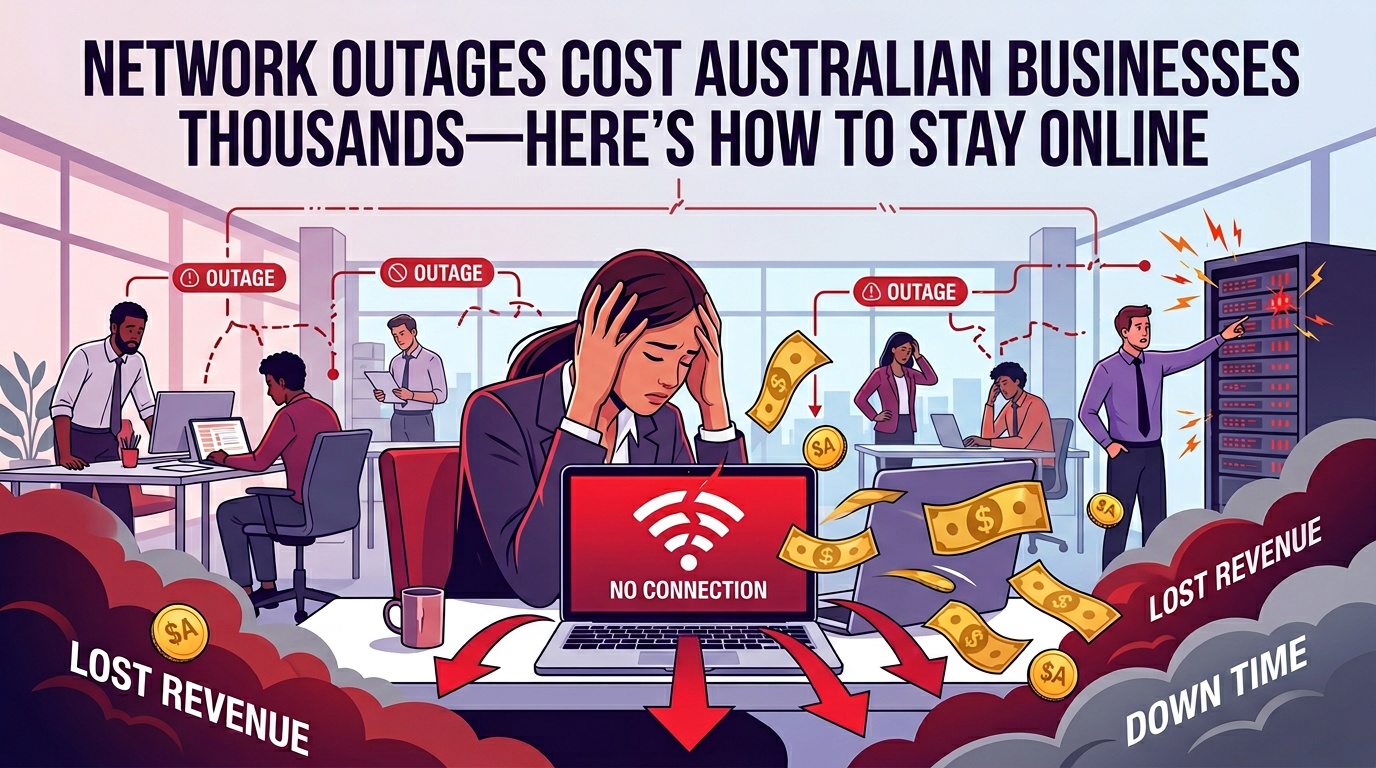
If your business relies on the internet—and in 2026, every business does—then a network outage is not just an inconvenience. It is a direct hit to your revenue, your staff productivity and your reputation.
VikingCloud’s 2026 SMB Threat Landscape Report found that 73 per cent of SMBs experienced Wi-Fi or network outages in the past year, alongside website failures, vendor disruptions and POS outages that directly affected daily operations and income.
Earlier Australian research paints an even starker picture: 98 per cent of Australian businesses suffered at least one Wi-Fi downtime incident per month, with the average cost exceeding $4,000 per outage hour and around $68,000 per year in lost productivity and remediation.
Modern SMBs route phones (VoIP), EFTPOS, POS terminals, SaaS platforms, CRMs, remote access and building systems over the same link. A single failure can halt revenue, support and internal workflows all at once.
The Real-World Impact
Here is what network downtime actually looks like inside an Australian small business:
- Immediate revenue loss — EFTPOS terminals go offline, online orders fail, POS systems freeze, and reception lines drop mid-call. Every minute counts.
- Staff idle time and overtime — Teams lose access to Microsoft 365, Xero, cloud CRMs and job management platforms, then scramble to catch up once connectivity returns.
- Customer and reputational damage — Clients who cannot reach you, complete a purchase or access your services will go elsewhere. Research shows many SMBs expect to lose customers after extended disruption.
The Australian Connectivity Landscape in 2026
Australia is one of the most connected countries in the world. Internet access reaches around 98 per cent of the population and mobile internet penetration sits above 90 per cent, making 4G and 5G a practical backup path in most locations.
National broadband infrastructure continues to improve. Fibre and satellite upgrades are reducing average outage frequency, and local providers increasingly position business NBN, fibre and fixed-wireless offerings with embedded 4G/5G failover, SD-WAN options and stronger SLAs—specifically for businesses that cannot afford downtime.
There is a mature ecosystem of business-grade NBN, fibre, satellite and mobile options in Australia—but many SMBs still rely on consumer-grade setups that do not match their uptime expectations. That gap is where Blue Moon IT steps in.
How Outages Typically Happen
Understanding the common causes of downtime is the first step towards preventing it. Most outages fall into four categories:
1. Access Network Issues
NBN faults, fibre cuts, street-level works and upstream routing problems cause last-mile or regional outages that are entirely outside your control. You cannot fix them—you can only be ready for them.
2. Single Points of Failure at the Site
This is the most common issue we see: a single low-cost router, one ISP, all Wi-Fi and wired networks hanging off the same consumer device, and no backup link. When that one device fails, everything stops.
3. Congestion and Poor Wi-Fi Design
Overloaded access points, interference in dense office environments and no Quality of Service (QoS) configuration often look like “the internet is down” to users, even when the WAN link is technically up. Choppy VoIP, slow SaaS and intermittent Wi-Fi drops are the warning signs.
4. Power and Equipment Failures
Sites with no UPS and no redundant router or access points can lose connectivity for the entire office after a brief power flicker. Multi-tenant buildings and regional centres with fragile local infrastructure are especially vulnerable.
The pattern we see most often: partial outages—Wi-Fi dropping in and out, choppy VoIP, slow cloud apps—build up over weeks or months, then culminate in a major incident when the underlying issues are not addressed.
Blue Moon IT’s Network Resilience Blueprint
At Blue Moon IT, we focus on four pillars: business-grade design, dual-path connectivity, proactive monitoring and tested runbooks. Together, they turn your network from a fragile single point of failure into a resilient foundation for operations.
Pillar 1: Business-Grade Network Design
Consumer all-in-one devices are designed for homes, not businesses. We deploy business-grade firewalls, routers and access points that support VLANs, QoS, dual-WAN and central management.
- Network segmentation — Separate VLANs for voice and critical apps, guest Wi-Fi and IoT devices (cameras, POS, printers). This reduces broadcast noise, improves security and enables application-aware traffic shaping.
- Quality of Service (QoS) — VoIP, EFTPOS and key SaaS are prioritised over bulk traffic such as backups, updates and media. When bandwidth is tight, non-critical services degrade first—not your phones or payment terminals.
Why this matters:
With proper segmentation and QoS, a single incident is far less likely to take down every service at once. Even during a failover to 4G, the most important functions remain usable.
Pillar 2: Dual-WAN and Diverse Paths (NBN + 4G/5G)
For high-impact sites—retail, medical, professional services, logistics—we recommend a primary business NBN or Enterprise Ethernet service backed by an automatic 4G/5G connection from a different carrier where possible.
- Business-grade routers continuously monitor the primary link and switch to mobile within seconds of a failure.
- In advanced designs, SD-WAN keeps sessions alive and can preserve public IP addressing, so staff often do not even notice the changeover.
- Using different access technologies or carriers for primary and backup avoids a single NBN or fibre issue affecting both paths.
With dual-WAN failover, most short- and medium-length outages become invisible: traffic moves automatically to the mobile path and work continues while the underlying fault is resolved.
Pillar 3: Proactive Monitoring, Alerts and Reporting
We do not wait for you to ring us. Centralised monitoring tracks WAN status and latency, Wi-Fi access point uptime and utilisation, and device health indicators such as CPU, memory and interface errors.
- Automated alerts via email, Teams, Slack or SMS trigger when primary WAN links go down or flap, packet loss or latency exceed thresholds, or access points and critical devices go offline.
- Monthly uptime and incident reports show each client their failover events, chronic packet loss patterns and congested Wi-Fi channels.
What this means for you:
Issues are often identified and addressed—by replacing failing hardware, re-tuning Wi-Fi or escalating to the ISP—before they escalate into noticeable outages. Data-driven reports also make the business case for upgrading from consumer NBN to business fibre with integrated 4G backup.
Pillar 4: Documented and Tested Outage Runbooks
When something breaks, you need a plan—not panic. Each site receives a tailored runbook that documents:
- Likely failure modes (ISP, router, Wi-Fi zones, VoIP platform).
- Clear triage steps for Level 1 and Level 2 support.
- Specific escalation paths to carriers and vendors.
- Expected failover behaviour, how to confirm 4G is active, which services may be limited on backup bandwidth, and what staff should do to prioritise business-critical work.
Pre-prepared communication templates help managers quickly explain to staff that the site is on a backup link, which services remain fully supported and which activities (such as streaming media) should be avoided.
Blue Moon IT also facilitates periodic failover tests—often quarterly—where the primary link is intentionally dropped to validate that backup connectivity and procedures perform as expected in production. This removes chaos and finger-pointing when something actually breaks, and ensures resilience is real, not theoretical.
Continuous Review of ISP Performance and Contracts
Using monitoring data and ticket history, Blue Moon IT tracks each ISP’s uptime, outage frequency, mean time to repair and support quality for every client site.
When an ISP repeatedly underperforms or misses SLAs, clients receive evidence-based recommendations to:
- Move to business-grade or Enterprise Ethernet offerings.
- Add a second carrier for path diversity.
- Renegotiate better SLAs and 4G backup options.
Over time, this shifts businesses away from “best-effort” consumer services towards connectivity that is engineered for business uptime, reducing repeat incidents from systemic issues.
Key Takeaways
- 73% of SMBs experienced network outages in the past year—many losing thousands per hour
- Consumer-grade routers and single-ISP setups are the most common cause of total site outages
- Business-grade design with VLANs and QoS ensures critical services stay up even when bandwidth is constrained
- Dual-WAN with automatic 4G/5G failover makes most short outages invisible to staff
- Proactive monitoring catches issues before they become outages
- Documented, tested runbooks remove panic and finger-pointing when incidents occur
- Regular ISP performance reviews ensure you are on the right plan with the right provider