
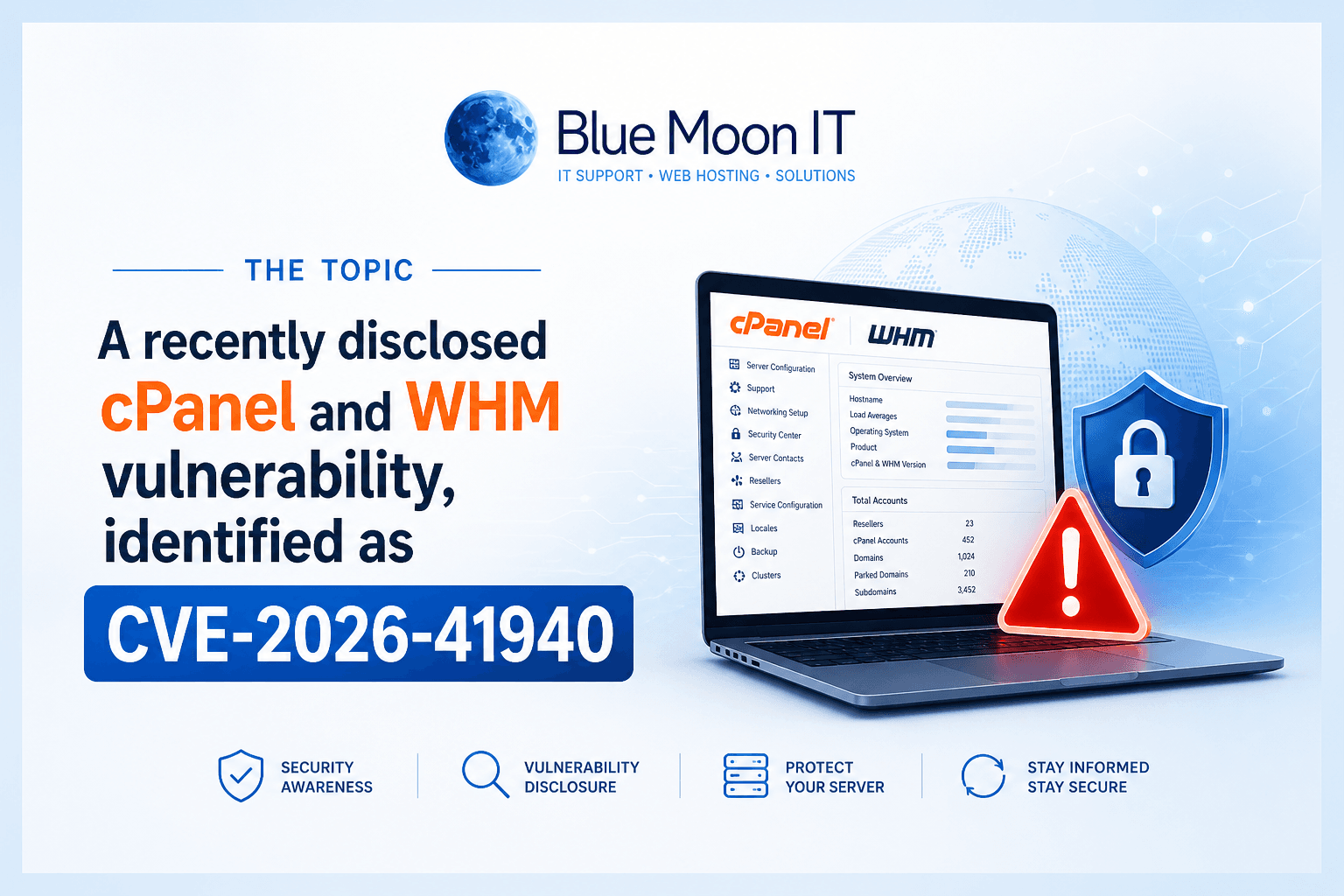
A recently disclosed cPanel and WHM vulnerability, identified as CVE-2026-41940, has created urgent concern for businesses that rely on cPanel hosting because it may allow unauthorised access to hosting control panels without a valid login. Security reporting and government advisories have confirmed the vulnerability has been actively exploited, which means business owners should treat this as a real operational risk rather than a routine software update.
If your website, email, or databases are hosted on cPanel, the issue is not limited to "technical backend systems." A successful compromise may expose website files, customer enquiries, email accounts, and administrative settings that your business depends on every day.
What cPanel controls
cPanel is the interface many businesses use to manage website files, domains, SSL certificates, email accounts, databases, backups, and application settings. WHM sits above cPanel and is commonly used to manage the server itself or multiple hosting accounts, which means a compromise at that level can have wider consequences across many websites and mailboxes.
That distinction matters for business owners because the exposure may not stop at a single website. If attackers gain broader administrative access, they may be able to alter hosting settings, create new privileged users, redirect services, or maintain long-term access inside the hosting environment.
What was exposed
Current reporting describes CVE-2026-41940 as a critical authentication bypass vulnerability affecting cPanel and WHM versions after 11.40, with a reported severity score of 9.8 out of 10. Security sources and Australian government guidance indicate that unauthenticated remote attackers may gain access to the control panel, and the ACSC has also warned of possible remote code execution in active exploitation scenarios.
For businesses, that may translate into exposure of:
- Website files, including content, themes, plugins, and application code.
- Customer form submissions and connected databases.
- Business email accounts that sit inside the same hosting environment.
- DNS and domain-related settings that control where your visitors and email traffic are sent.
- Administrative access that can be used to install malware, create persistence, or hide future tampering.
This is why a cPanel vulnerability can quickly become a broader business continuity issue. Even if your public website looks normal, attackers may still have changed mail settings, created hidden access points, or copied sensitive data behind the scenes.
Critical Severity: CVSS Score 9.8 / 10
CVE-2026-41940 has been rated critical and is being actively exploited. The Australian Cyber Security Centre (ACSC) has flagged this vulnerability and warned of possible remote code execution in live attacks.
Why business owners should care
When a hosting panel is compromised, the damage often spreads beyond a single page being defaced. Attackers may use access to steal data, send phishing messages from your domain, inject malware into your website, or quietly prepare for a later attack.
For business owners, the outcomes can include:
- Website downtime and lost sales or leads.
- Reputational damage if customers are redirected or exposed to malicious content.
- Email blacklisting if attackers send spam or phishing from your domain.
- Recovery costs, emergency support fees, and prolonged disruption to staff.
- Potential legal and compliance consequences if customer information is exposed.
In short, this is not just an IT problem. It can affect customer trust, cash flow, communications, and your ability to operate normally.
What to check right now
The first step is to confirm whether your hosting environment has already been patched against CVE-2026-41940. Reporting on the emergency fix identified patched builds including 11.110.0.97, 11.118.0.63, 11.126.0.54, 11.132.0.29, 11.134.0.20, and 11.136.0.5.
If you use a third-party hosting provider, ask them these direct questions:
- Has our cPanel or WHM environment been patched against CVE-2026-41940?
- Are we running a supported cPanel version?
- Have you checked for signs of compromise before and after patching?
- Have administrator passwords, email credentials, and other access tokens been reviewed or rotated where needed?
- Do we have recent clean backups, and have restore procedures been tested?
You should also be cautious about vague answers. A business owner should expect a clear response about patch status, supported versions, logging, backups, and whether the provider has looked for unauthorised changes or persistent access.
How to fix it properly
Applying the patch is essential, but it should not be the end of the response because the vulnerability has reportedly been exploited in the wild. If a system was exposed before patching, a business may still face hidden risks unless the hosting environment is reviewed properly.
A proper remediation process should include:
- Confirming the server is fully updated to a patched and supported version.
- Reviewing cPanel, WHM, web, SSH, and email logs for suspicious access or behaviour.
- Checking for unexpected users, cron jobs, modified files, redirects, malware, and web shells.
- Rotating passwords and sensitive credentials linked to hosting, email, FTP, and databases.
- Verifying that backups are clean before restoring any affected content.
- Hardening the environment to reduce future exposure, including better update management and tighter administrative access controls.
For many businesses, the difficult part is not installing an update. It is confirming whether anything was accessed, changed, or left behind before the patch was applied.
If your provider cannot clearly explain your patch status, version support, backup readiness, and post-incident checks, now is the time for an independent review.
Key Takeaways:
- CVE-2026-41940 is a critical authentication bypass in cPanel and WHM with a CVSS score of 9.8 out of 10.
- The vulnerability affects versions after 11.40 and has been actively exploited in the wild.
- Patching alone is not sufficient — a full post-incident review is required to rule out persistent access.
- Business exposure includes website files, email accounts, databases, DNS settings, and administrative access.
- Ask your hosting provider direct questions about patch status, supported versions, backup readiness, and post-incident checks.
- Blue Moon IT can provide an independent hosting security review if your provider cannot give clear answers.